• Home
  • Business Overview 2025
  • More
    • Home
    • Business Overview 2025
  • Sign In
  • Create Account

  • My Account
  • Signed in as:

  • filler@godaddy.com


  • My Account
  • Sign out

Signed in as:

filler@godaddy.com

  • Home
  • Business Overview 2025

Account

  • My Account
  • Sign out

  • Sign In
  • My Account
Regulation D Rule 506c - Accredited Investors Only

Thrasher #1

Seidler Oil and Gas is an independent energy company focused on oil and natural gas exploration and the development of Salt Water Disposal (SWD) facilities. Our mission is to deliver profitable, diverse investment opportunities through unparalleled service and a commitment to excellence.

Seidler Oil and Gas Web Site

Asset Location:

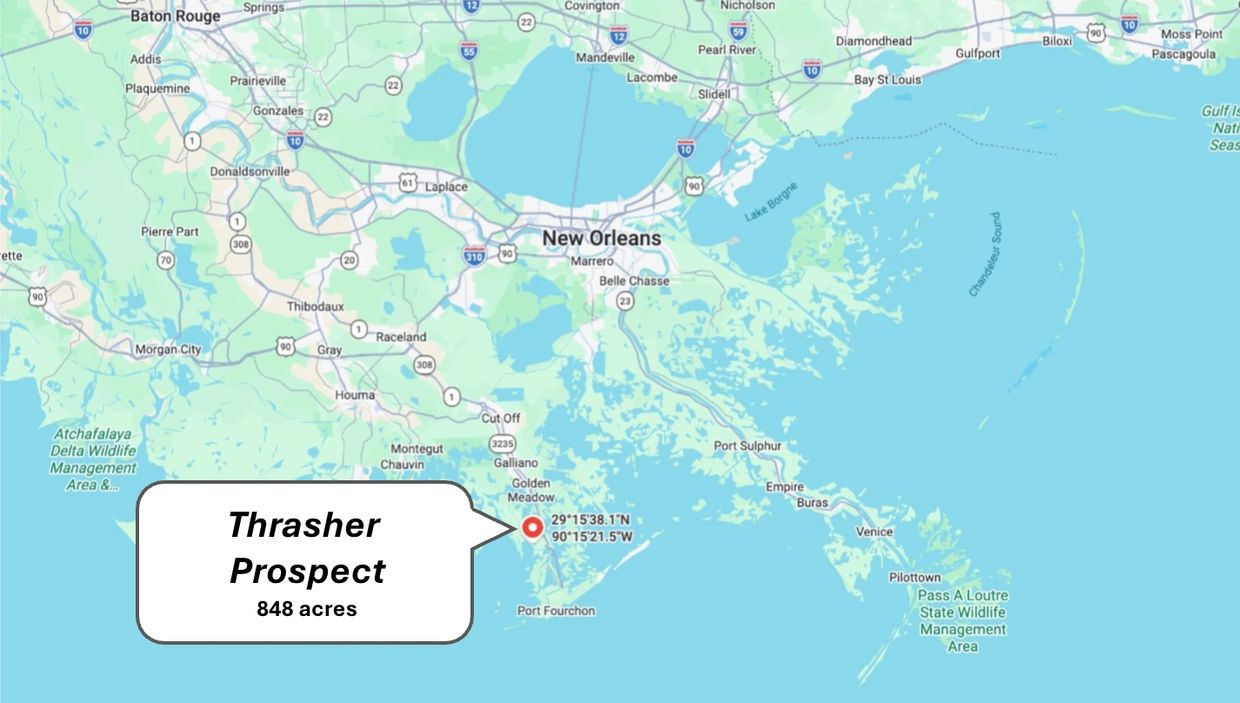
The surface location for the well is situated in Lafourche Parish, Louisiana, specifically targeting the western flank of the Leeville Dome in the Lake Raccourci area. The prospect spans a total of 848 acres (Maximum outline) situated within the highly productive Tex L trend. 

Primary Target:

The primary objective lies at approximately ~13,500' TVDSS, zeroing in on the regional Textularia L producer interval—specifically the Leeville North Flank 95 and 96 sands, alongside the PCC/GG/HH sand series in the southwest block.

Structural Trap & Seismic Support:

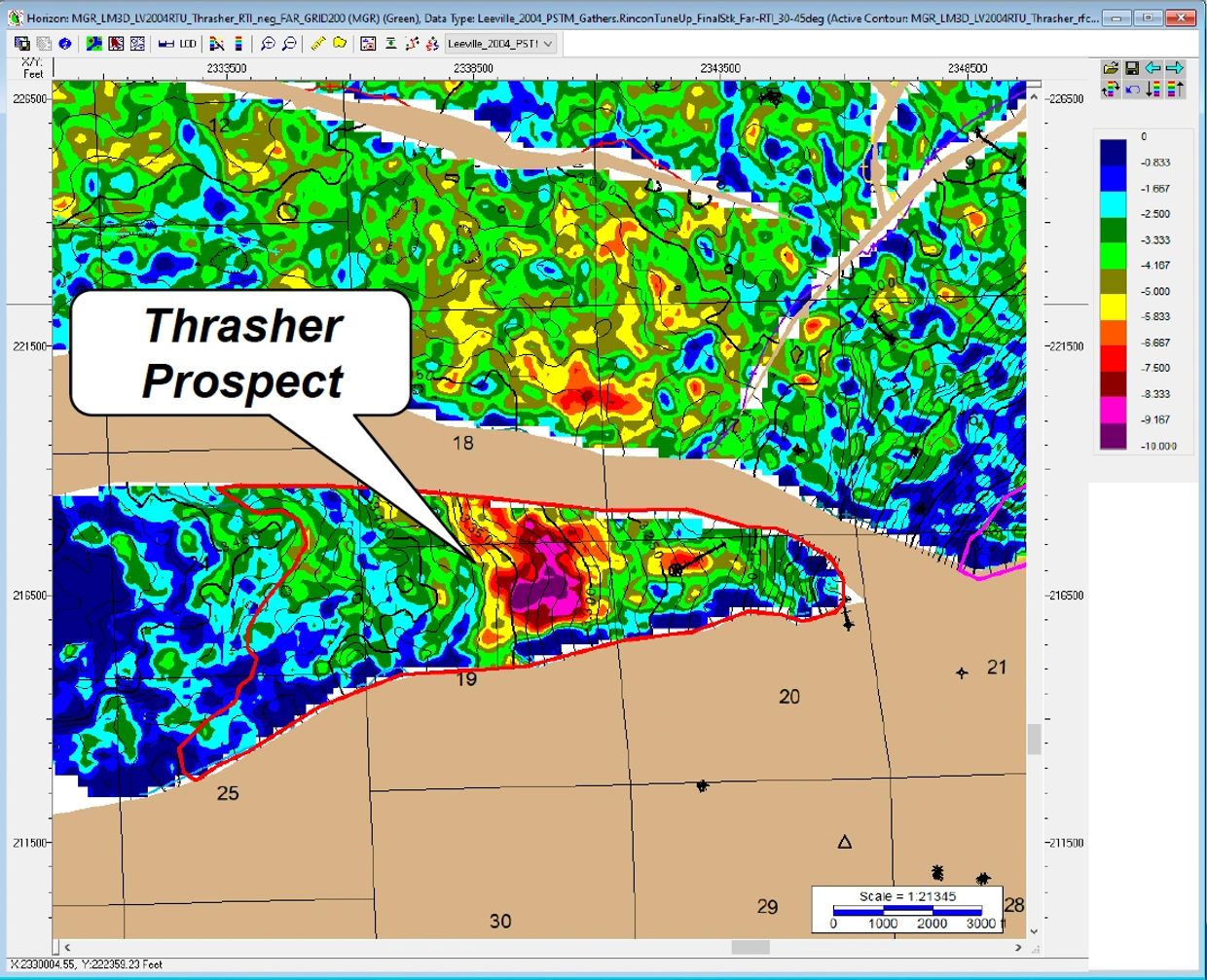
Thrasher is a clearly defined, fault-bounded trap. Modern seismic evaluation demonstrates powerful hydrocarbon indicators, showing a strong Class IIp / III AVO anomaly featuring a leading negative trough and a potent trailing peak composite amplitude.

Louisiana’s oil and gas sector experienced a significant rebound and regulatory overhaul in 2025, driven by surging natural gas production, major infrastructure milestones, and state tax reforms. State production rebounded as producers capitalized on growing demand for LNG, increased offshore lease sales, and state-level incentives. ​
​

Drilling & Production Activity​

  • Rig Count: Louisiana concluded the year with 47 active drilling rigs. Of these, 30 were in North Louisiana (targeting the Haynesville Shale), 8 in South Louisiana, and 9 operating offshore in the Gulf of Mexico. ​


  • Natural Gas Resurgence: After a two-year slump, Louisiana’s natural gas output surged. Production bottomed out at 264,000 million cubic feet (MMcf) in February and rebounded to 336,500 MMcf by March, spurred by Henry Hub futures topping $4/MMBtu. ​


  • Permitting: Through early 2025, the state issued 93 drilling permits in the first quarter alone, reflecting consistent exploration and production across the Haynesville. ​

Midstream Infrastructure​

  • Pipeline Expansions: Midstream operators completed major projects to connect Haynesville shale production directly to the Gulf Coast. The Louisiana Energy Gateway added 1.8 Bcf/d of intrastate capacity, while the New Generation Gas Gathering system added 1.7 Bcf/d, both leading to the Gillis Hub in southeast Louisiana.​


  • LNG Feedgas Pipelines: Interstate additions such as the Evangeline Pass Expansion (1.1 Bcf/d) and East Lateral Xpress (0.3 Bcf/d) came online to deliver feedgas directly to Plaquemines LNG. ​

While South Louisiana is historically famous for its thick, highly permeable conventional sands, the strategic deployment of modern stimulation and modern multi-stage hydraulic fracturing has fundamentally redefined the region's recovery economics. Historically, legacy vertical wells in these fairways relied solely on natural reservoir pressure and open-hole completions, which often left significant hydrocarbons trapped in place.


Today, the application of tailored fracturing technology directly to vertical and directional wellbores makes a massive difference in both the initial flow rates and the ultimate cumulative volume a well can produce. By utilizing advanced proppant designs and precisely engineered fracture treatments, operators can aggressively break down tight reservoir barriers, bypass near-wellbore formation damage, and dramatically expand the drainage radius of a single vertical footprint. This technological evolution effectively transforms marginal or dense intervals into highly efficient, high-volume producers, ensuring fast capital payback and maximizing the total recoverable asset value.


Positioned within the prolific Tex L fairway of Lafourche Parish, South Louisiana, the Leeville flank represents a highly strategic, asset-rich frontier for modern independent operators. Long recognized for its historic, multi-million-barrel hydrocarbon yields, this specific region is undergoing a major technological renaissance. The integration of legacy production data with modern 3D seismic, advanced relative impedance amplitude tracking, and precise directional drilling has unlocked premium, unswept structural compartments that rival the economics of the country's core conventional plays. 


Seismic-Proven Assets in South Louisiana

Every world-class oil field leaves clues along its margins. In the heart of Louisiana’s proven, oil-prone fairway, the Thrasher Prospect represents a highly defined, premium exploration opportunity targeting an untapped structural fault block on the western flank of the massive Leeville Dome. While the greater Leeville area has historically produced a staggering 96.3 MMBO and 243.2 BCF across all levels, this specific fault block remains entirely untested.


Backed by dense 3D seismic, robust Amplitude Versus Offset (AVO) anomalies, and unmistakable fluid factor support, Thrasher is not a wildcat gamble—it is a surgical offset to multi-million-barrel legacy production. Rincon Energy has mapped a substantial, oil-weighted asset with thick target sands, exceptionally clear analog behavior, and a direct line to Gulf Coast infrastructure, offering incoming partners a high-conviction, fast-payout venture in a proven productive fairway.

Well Plan & Operations

A highly targeted, deviated well path has been designed to launch from a secure surface location and intersect the prospective pay intervals cleanly within the fault block:


  • Kick-Off Point (KOP): Vertical drilling down to 10,950' TVD, at which point a 2.0 directional build begins.


  • Target Intersections: The well path will intersect the primary North Flank 95 Sand at -13,389' TVDSS (13,541' MD) and the deeper North Flank 97 Sand at -14,377' TVDSS (14,551' MD).


  • Proposed Bottom Hole (PBHL): Designed to reach a Total Depth (TD) of 14,500' TVD / 14,682' MD just below the interpreted 97 sand base.

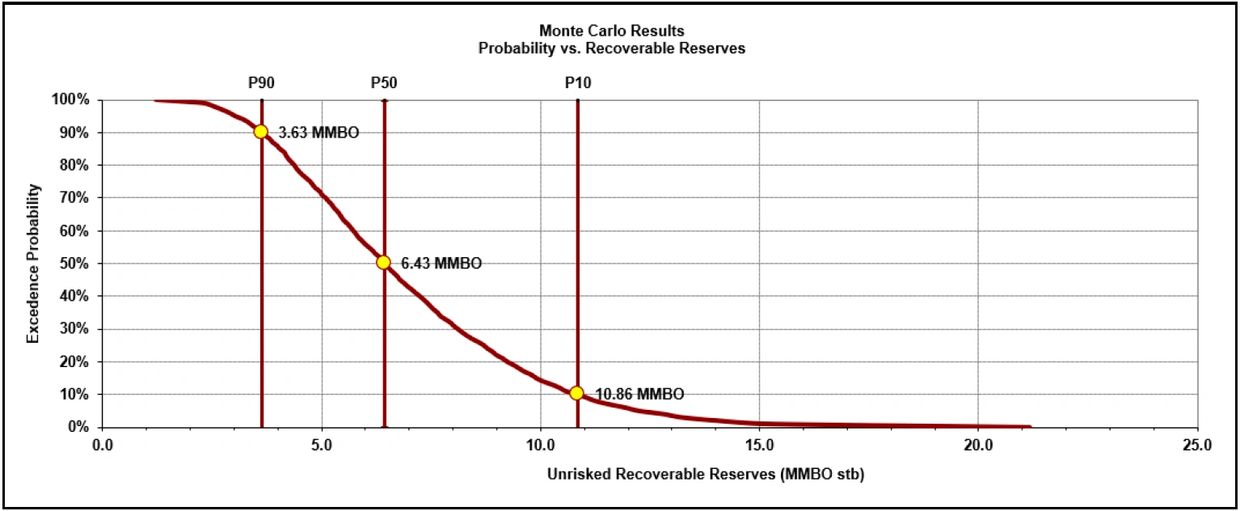
Prospective Recoverable Reserves (Unrisked)


Metric                              Oil Volumes (MMBO)                Gas Volumes (BCF)


P90 (Low Case)                       3.63 MMBO                                7.26 BCF

P50 (Most Likely Case)           6.43 MMBO                              12.90 BCF

P10 (High Case)                     10.86 MMBO                              21.72 BCF

3D Seismic and Modern Drilling Technology

Drastic Reduction in Dry Hole Rates

Before the widespread adoption of 3D seismic technology, exploratory drilling was guided by 2D data, which offered only a flat, cross-sectional view of the earth. Success rates for exploratory wells hovering around deep or complex structures were often below 20–30%.


  • The 3D Seismic Advantage: By sending acoustic waves into the ground and recording the reflections, geophysicists can map the subsurface in three dimensions. This allows operators to visualize fault lines, salt domes, and stratigraphic traps with incredible clarity before a drill bit ever touches the ground.


  • The Statistic: In modern deep-water and shelf drilling, the application of high-resolution 3D (and time-lapse 4D) seismic data has pushed exploratory success rates well above 50% to 70%, and development well success rates often exceed 90%.

Enhanced "Drilling Efficiency" (Days vs. Depth)

At great depths, the time spent drilling equates directly to millions of dollars. Modern drilling technology has dramatically flattened the "learning curve" for deep wells.


  • Modern Drill Bits and Rigs: The introduction of Polycrystalline Diamond Compact (PDC) drill bits, automated top drives, and high-efficiency mud pumps allows rigs to cut through hard rock formations much faster.


  • The Statistic: The average time required to drill a deep well (e.g., 15,000+ feet) has decreased by 30% to 50% over the last two decades. What used to take 60 days can now frequently be completed in 30 to 40 days, significantly reducing the cost per foot drilled.

Precision Placement with Geosteering

Drilling a vertical well into a deep reservoir requires hitting a target that may only be a few dozen feet wide, miles beneath the surface. For directional or horizontal wells branching off from these depths, the challenge is even greater.


  • Measurement/Logging While Drilling (MWD/LWD): Modern drill strings are equipped with sensors near the bit that transmit real-time data (gamma ray, resistivity, porosity) back to the surface. Combined with 3D seismic models, engineers use "geosteering" to adjust the path of the well live.


  • The Statistic: Modern geosteering allows operators to stay within the "pay zone" (the most productive layer of the oil reservoir) more than 90% to 95% of the time, compared to less than 60% using older, blind drilling methods. This precision maximizes the well's eventual oil production.

Reduced Non-Productive Time (NPT)

Deep drilling faces immense downhole pressures and temperatures (HPHT environments), which historically caused catastrophic equipment failures, stuck pipe incidents, or wellbore collapses.


  • Managed Pressure Drilling (MPD): Modern automated fluid systems precisely control the pressure profile inside the wellbore during drilling. This prevents dangerous fluid influxes (kicks) and stops the wellbore walls from caving in.


  • The Statistic: The percentage of total rig time lost to Non-Productive Time (NPT) due to mechanical failures or wellbore instability has dropped from historical highs of 20–25% down to under 5–8% on modern, technologically advanced operations.


By combining the structural "map" provided by 3D seismic with the real-time adjustments and ruggedness of modern drilling hardware, operators in regions like the Louisiana shelf can reliably target deep oil reserves that were previously considered too risky or economically unfeasible to drill.

Proven Fairway & Production History

The Thrasher Prospect sits within a heavily digitized, historically prolific Tex L production fairway surrounding the Leeville Dome. The primary structural thesis—that fault-bounded traps along the western flank hold trapped, unswept commercial hydrocarbons—is directly proven by six adjacent, productive fault blocks that have collectively given up 19.19 MMBO and 49.77 BCF. 


Modern 3D seismic and relative impedance fluid factor data show that the Thrasher target matches the exact geophysical signatures of these high-rate legacy producers:

Key nearby commercial hits include:
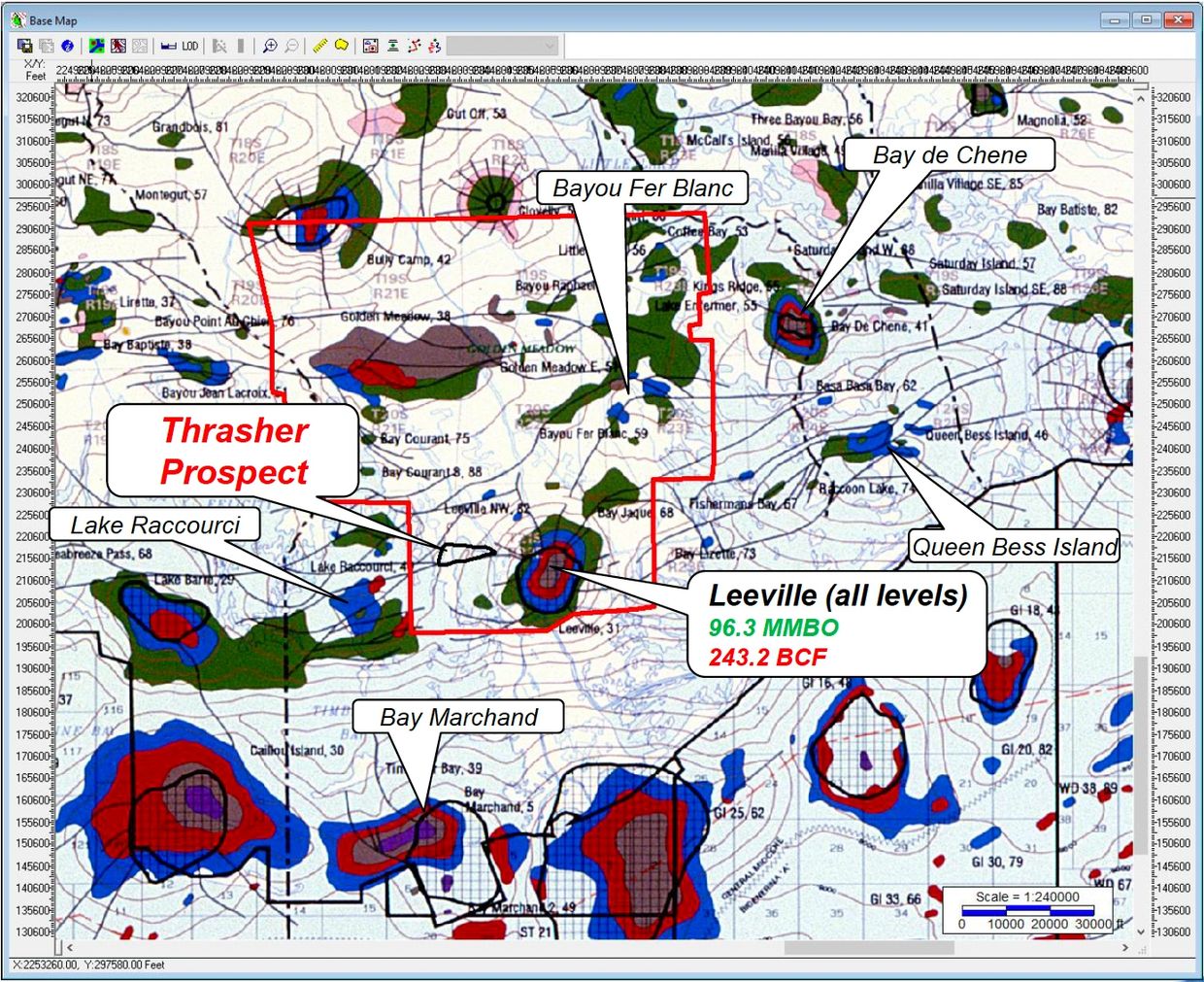

  • Texaco SL1908 LPSB #3: Produced 1.15 MMBO and 1.70 BCF from the exact target 95 and 96 sands.


  • CNO LL&E #28: Produced 2.94 MMBO and 5.71 BCF out of a nearly identical fault wedge trap configuration.

Target: Unlocking the Leeville Flank

The geological logic for the Thrasher Prospect is backed by a quantitative, risk-adjusted valuation utilizing a Monte Carlo statistical distribution model. Rather than relying on a singular deterministic estimate, this probabilistic framework captures the full range of potential outcomes based on real reservoir variables from the surrounding Leeville field. 


The calculations integrate local formation metrics, modeling an average net porosity range of 21% to 27%, water saturation levels between 35% and 45%, and a standard oil formation volume factor of 1.4. The resulting unrisked recoverable reserves yield a highly compelling, oil-prone resource target: 


  • P90 (Low-Risk Case): Establishes a firm economic baseline of 3.63 MMBO of oil and 7.26 BCF of natural gas. This structural minimum assumes a conservative reservoir footprint of 182 acres and a net pay thickness of 25 feet. 


  • P50 (Most Likely Case): Represents the primary target case of 6.43 MMBO of oil and 12.90 BCF of gas. This model represents the most statistically probable scenario, tracking an estimated 420-acre structural trap with 50 feet of net pay thickness and a recovery factor parameter of 239 bbl/acre-ft. 


  • P10 (High-Upside Case): Unlocks an expansive maximum potential of 10.86 MMBO of oil and 21.72 BCF of gas. This case accounts for the maximum mapped structural extent of 848 acres with an optimized net pay thickness of up to 100 feet and a premium 340 bbl/acre-ft recovery factor.

Investment Takeaway:

The seismic attributes at Thrasher show an anomalously negative far-angle amplitude response that directly correlates with the post-3D "unswept" pay responses seen in these core analogs. This indicates that Thrasher is an overlooked, fully insulated compartment containing the same thick, oil-prone sands that drove Leeville's multi-million-barrel legacy success. 
View the complete Executive Summary for The Thrasher Prospect Prepared by Rincon Energy, LLC | February 2026

3D Seismic and Geoscience Data

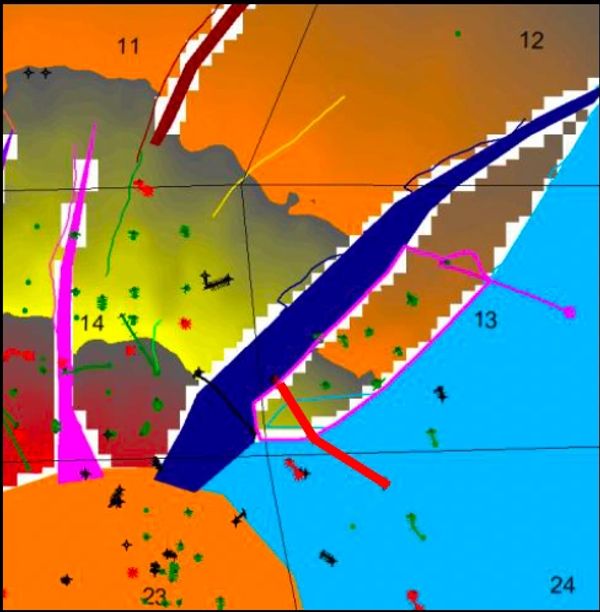
 Relative Impedance far angle amplitudes at Thrasher anomalously negative and consistent with post-3D “unswept” 95 sand pay response.  
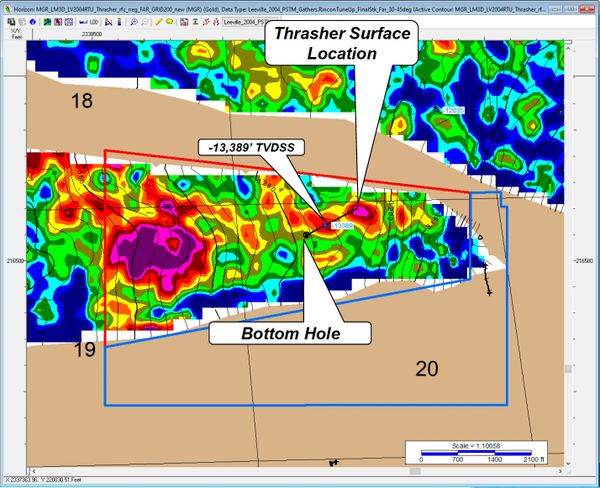
Thrasher Far Stack


The Thrasher well plan will intersect the target NF95 sands in an area with a good amplitude response. 
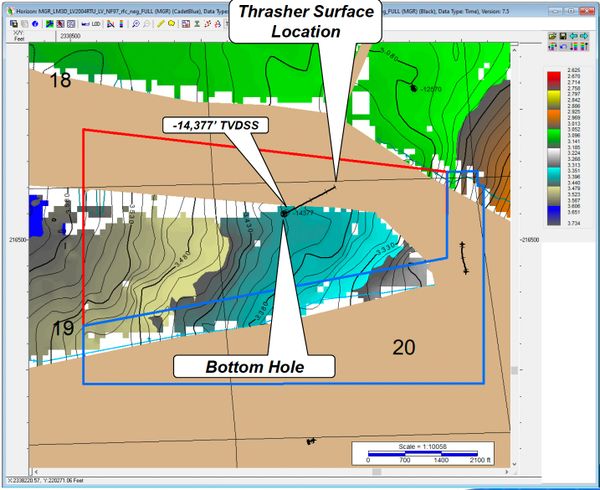
North Flank 97 Sand Time Structure

  Top North Flank 97 sands Time Structure Map

North Flank 97 sand cut points posted at wells.

The Thrasher well plan will intersect the North Flank 97 sands @ 14,551MD / -14,377’ TVDSS just south of one of the Thrasher bounding faults. 

Well Cross Section


The SLCN #10 95 and 96sands are juxtaposed against upthrown sands to the northwest across the dark blue fault, and against downthrown sands to the southeast across the light blue fault.
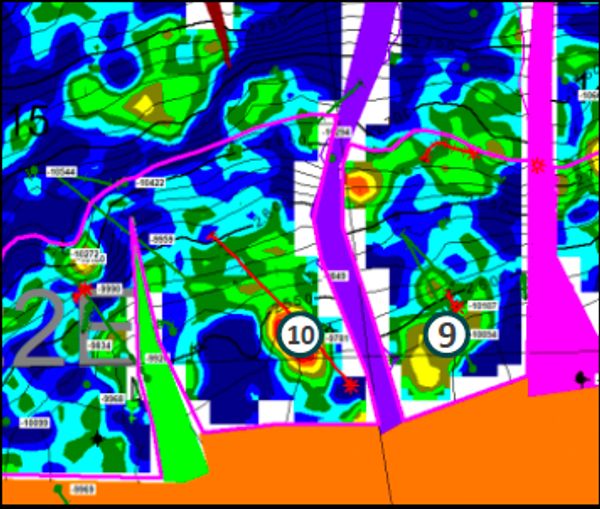


Leeville Northeast 95 Sand Analog

Thrasher 2004 Leeville Angle Gathers

Thrasher 2004 Leeville Angle Gathers

 The SLCN #10 95 and 96sands are juxtaposed against upthrown sands to the northwest across the dark blue fault, and against downthrown sands to the southeast across the light blue fault. 

Thrasher 2004 Leeville Angle Gathers

Thrasher 2004 Leeville Angle Gathers

Thrasher 2004 Leeville Angle Gathers


Gathers display anomalous Class IIp / IIIAVO inprospect interval 

Economics and Reserves

Prospective Recoverable Reserves (Unrisked)


Metric                              Oil Volumes (MMBO)                Gas Volumes (BCF)


P90 (Low Case)                       3.63 MMBO                                7.26 BCF

P50 (Most Likely Case)           6.43 MMBO                              12.90 BCF

P10 (High Case)                     10.86 MMBO                              21.72 BCF
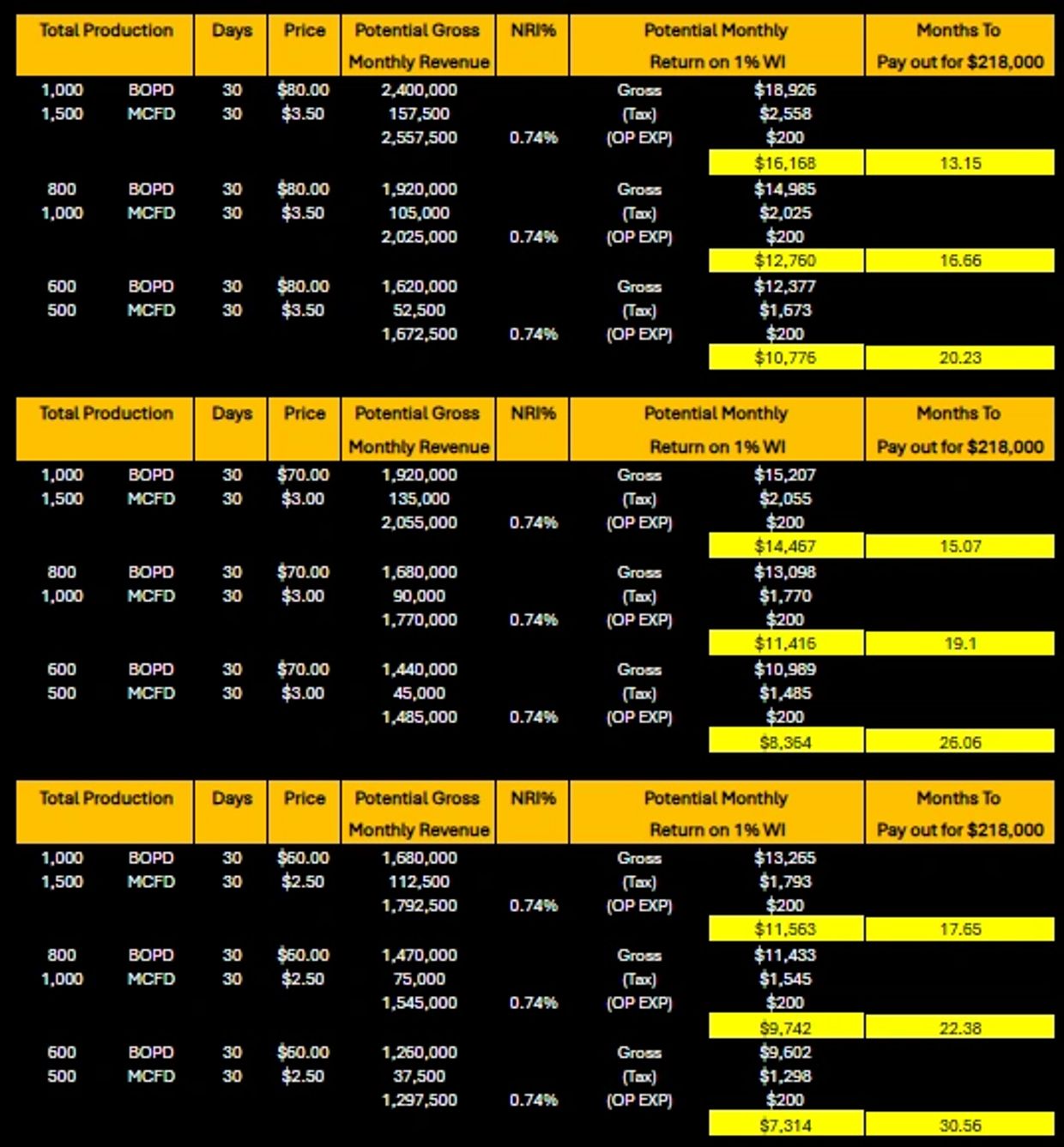
THIS ILLUSTRATION REPRESENTS ONLY AN ESTIMATE OF REVENUE THAT MAY BE RECEIVED WITH RESPECT TO A ONE PERCENT WORKING INTEREST AND THE

PRODUCTION LEVELS STATED. VARIANCES IN PRODUCTION RATES, COMMODITY PRICES, AND LEASE OPERATING EXPENSES WILL DIRECTLY IMPACT NET REVENUE.

THIS ILLUSTRATION IS SUBJECT TO ALL OF THE RISKS DESCRIBED IN "RISK FACTORS" AND ELSE WHERE IN THE PRIVATE PLACEMENT MEMORANDUM YOU RECEIVED.

THIS PROSPECT COULD BE A "DRY HOLE" AND RESULT IN ZERO REVENUE

Project Features

3D Seismic and Modern Geoscience

3D seismic technology serves as the ultimate engine for discovery, turning unseen subsurface traps into highly defined, predictable drill targets. Relying on vintage well logs alone leaves massive blind spots, but modern 3D seismic acts as a high-resolution medical scan of the Earth, allowing operators to peer deep into the subsurface with pinpoint precision.

Directional Drilling

Directional drilling is a technology that allows operators to launch from a single surface location, navigate miles beneath the earth, and curve a wellbore with pinpoint precision directly into the most productive oil and gas zones. Whether it’s steering beneath complex faults, tapping into untouched 'unswept' reserves, or maximizing total well production, directional drilling has completely redefined what's possible in subsurface engineering.

Hydraulic Fracturing

Hydraulic fracturing is no longer just for horizontal wells; applying modern frac technology to vertical wells completely changes the game. By pumping precisely engineered fluids and proppants into a vertical wellbore, operators can shatter tight rock barriers, bypass localized formation damage, and dramatically expand the well's drainage area. This simple stimulation technique aggressively boosts initial flow rates and unlocks significantly more oil and gas from a single vertical footprint than conventional methods ever could.

Downloads

Lizzy #1H Two Well Program - Summary (pdf)Download
Lizzy PPM (pdf)Download
Lizzy Sub-Docs (pdf)Download
  • Home
  • terms of service
  • legal disclaimer
  • Thrasher #1
  • EFG Four Well Project LP

OilWellStore PM, LLC

2140 E. Southlake Blvd. L538 Southlake, Texas 76092

+1.8179664732

Copyright © 2025 OilWellStore PM, LLC - All Rights Reserved.

Powered by

This website uses cookies.

We use cookies to analyze website traffic and optimize your website experience. By accepting our use of cookies, your data will be aggregated with all other user data.

Accept